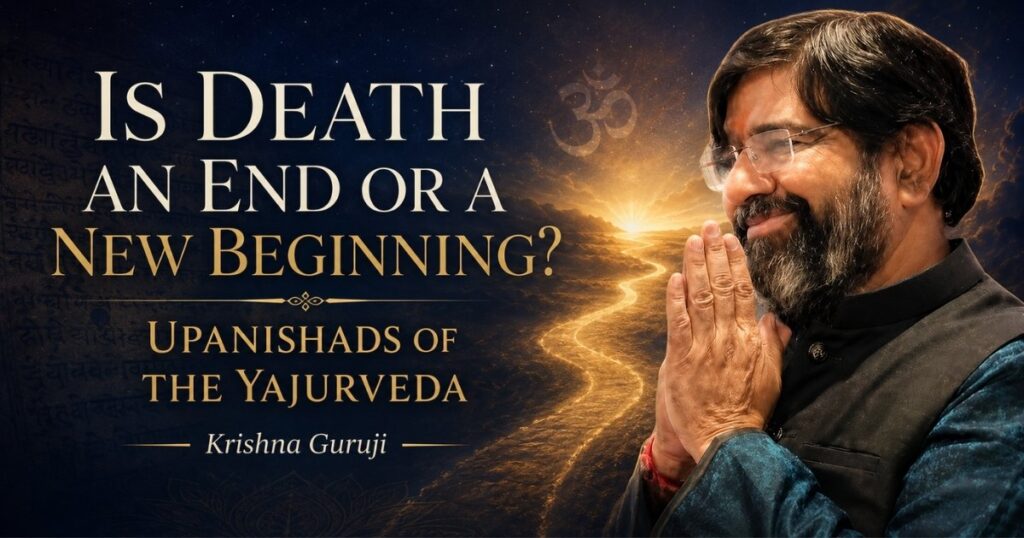
Is death an end or a new beginning? This question arises in almost every human mind at some point in life. Thousands of years ago, the young seeker Nachiketa asked Yama, the Lord of Death, the same question.
Modern science has made extraordinary progress. However, the mysteries of death, consciousness and the Self have not been completely resolved. Therefore, this article explores the Upanishads of the Yajurveda through simple language, spiritual reflection and a modern perspective.
What Are the Upanishads?
The Upanishads represent an important philosophical and spiritual dimension of the Vedas. In ancient times, disciples sat close to their Guruji and asked the deepest questions of life.
These questions concerned the Self, God, nature, consciousness, karma, and death. The Upanishads preserved many such meaningful dialogues between Guruji and disciples.
However, the Upanishads do not merely provide ready-made answers. They also encourage every human being to reflect, enquire and seek truth through personal understanding.
The purpose of the Upanishads is not to end our questions but to deepen our journey towards truth.
Principal Upanishads of the Yajurveda
The Yajurveda has two principal traditions: the Shukla Yajurveda and the Krishna Yajurveda. Several important Upanishads are associated with these traditions:
- Isha or Ishavasya Upanishad
- Brihadaranyaka Upanishad
- Katha Upanishad
- Taittiriya Upanishad
- Shvetashvatara Upanishad
- Maitrayaniya Upanishad
It is not necessary for everyone to memorise these difficult names. Instead, it is more useful to understand the practical questions and life lessons found within them.
Where Is God?
The Ishavasya Upanishad begins with a profound declaration:
ईशावास्यमिदं सर्वं यत्किञ्च जगत्यां जगत्।
Its simple message is that the entire universe is pervaded by divine consciousness. This teaching inspires the belief that God exists in every particle of nature.
Consequently, we should respect trees, water, air, the Earth and every living being. Serving and protecting nature can also become a form of service to the Divine.
If the Divine exists throughout creation, harming nature cannot be separated from harming life itself.
Is Death an End or a New Beginning?
In the Katha Upanishad, Nachiketa asks Yama what happens after death. He wants to know whether everything ends when the physical body dies or whether a spiritual consciousness exists beyond the body.
Yama explains that the body changes and eventually perishes. However, the Upanishad describes the Atman as eternal and indestructible:
न जायते म्रियते वा कदाचित्।
नायं भूत्वा भविता वा न भूयः।
अजो नित्यः शाश्वतोऽयं पुराणो।
न हन्यते हन्यमाने शरीरे॥
The verse presents the Atman as beyond ordinary birth and death. Although the physical body comes to an end, the essential nature of the Self is not considered destroyed.
The Simple Example of a Bulb and Electricity
We can explain this spiritual idea to younger generations through a simple example.
Imagine that a bulb is glowing in your home. When you turn off the switch, the light disappears. Nevertheless, electricity has not vanished from the entire world. Only the electrical flow reaching that particular bulb has stopped.
Similarly, we may understand the body as an instrument. As long as life and consciousness remain active, the body continues to function. When the body becomes inactive, our direct observation of its consciousness also ends.
However, this example is only a metaphor for understanding a spiritual teaching. It does not constitute scientific proof of the soul or life after death.
The Battery and the Energy of the Body
A mobile phone works as long as its battery has sufficient power. Once the battery runs out, the phone switches off and requires charging.
In a comparable way, food, water, breath and rest provide the body with the strength needed for its biological functions. Breath, in particular, is an important sign of active life. Therefore, Yoga and Pranayama give special attention to balanced and conscious breathing.
Still, the biological energy of the body and the spiritual concept of Atman are not identical scientific ideas. Their comparison may help explain a spiritual subject, but we should not present it as a proven scientific conclusion.
Can the Soul Be Described as Energy?
Science tells us that physical energy can transform from one form into another. Yet physical energy and the spiritual Self have different definitions.
Ancient Rishis explored the mystery of existence through the language of Atman, Brahman and consciousness. In contrast, modern science examines the body, brain, matter and measurable energy through scientific instruments and evidence.
Therefore, we may use an energy analogy to make a spiritual discussion easier to understand. However, current scientific knowledge does not allow us to prove that physical energy and the soul are exactly the same.
Spirituality may raise a question, while science asks for measurable evidence. A meaningful dialogue must respect both approaches.
Rebirth and the Question of Evidence
Indian philosophy includes the concepts of karma, rebirth and Moksha. According to these traditions, human actions influence the spiritual journey of an individual.
However, universally accepted scientific evidence does not exist for verifying every claim of rebirth. Therefore, we should avoid making absolute declarations about the next birth of any individual.
Instead, we should focus on improving our actions in the present life. Good actions can immediately benefit our family, society, humanity and nature.
Rather than worrying only about the next life, we should make this life meaningful through compassionate action.
The Message of a Lamp
When a lamp burns inside a temple, its light spreads throughout the temple. If the same lamp burns in the home of someone in need, it removes darkness from that home.
Thus, the value of energy also depends upon its direction and use. In the same way, knowledge should contribute to the welfare of society.
Merely collecting spiritual information is not enough. We must apply wisdom through our behaviour, compassion and service to humanity.
Excess of Everything Can Become Poison
I frequently share a simple message:
“Excess of everything is poison.”
Excessive food may create heaviness and laziness in the body. Similarly, too much sleep can affect our activity and discipline.
Excessive anger may damage relationships, while uncontrolled ego can weaken our judgement. Even an overload of information may create confusion instead of wisdom.
Therefore, we should receive only as much knowledge as we can understand, absorb and apply meaningfully in life.
Consider Time, Person and Place Before Speaking
The Upanishads do not teach us only about the soul and death. They also encourage practical wisdom in everyday behaviour.
Before speaking, we should consider three important factors:
- Time: Is this the right moment to say it?
- Person: Who is the person receiving these words?
- Place: Is this the appropriate place for the conversation?
Even a correct statement can create tension when spoken at the wrong time. On the other hand, thoughtful words spoken at the right moment can protect relationships.
Therefore, we should pause briefly before speaking. We should consider the time, the person, the place and the possible effect of our words.
People Also Form Opinions According to the Place
Imagine two people standing outside a temple and talking. Observers may naturally assume that they are discussing religion or spirituality.
Now imagine two saints standing in an inappropriate place. People may form a negative opinion without knowing the truth of the situation.
This example shows that circumstances can influence public perception. Therefore, our words, actions and surroundings should remain in proper balance.
Watch the Video on the Katha Upanishad and Modern Science
In this Hindi video, Krishna Guruji explains Nachiketa’s question, the mystery of death and the relationship between spiritual enquiry and modern science:
Watch the complete video on YouTube
Meditation and Self-Reflection
Sit peacefully for a few moments. Close your eyes gently and take a deep breath. Then bring your complete attention to the natural flow of your incoming and outgoing breath.
Keep a feeling of goodwill for society and the entire world. Now repeat these resolutions silently:
I will not allow any person, object or situation to become greater than my inner balance.
Before speaking, I will consider the right time, person and place.
My words will connect hearts rather than break them.
Om Namah Shivaya.
Is Death an End or a New Beginning? The Conclusion
Nachiketa’s question in the Katha Upanishad remains relevant today. The Upanishads describe the Atman as eternal and the physical body as changeable.
Modern science, on the other hand, examines life and consciousness through observation, evidence and experimentation. Therefore, spirituality and science should remain in dialogue without forcing both to appear identical.
Ultimately, while reflecting on the mystery of death, we must not forget to make our present life meaningful. Our actions should serve humanity, society and nature.
This is a practical way to bring the wisdom of the Upanishads of the Yajurveda into life during Kaliyug.
Life is yours; the suggestion is mine. — Krishna Guruji
Continue the Journey of Vedic Wisdom
Upanishads of the Rigveda: Aitareya and Kaushitaki
Upanishads of the Samaveda: Kena and Chandogya
Upanishads of the Atharvaveda: Om and the Four States of Consciousness
Read the original Hindi article:
क्या मृत्यु अंत है या एक नई शुरुआत?
For authentic information about the Upanishads and Vedic traditions, visit the
Vedic Heritage Portal, Government of India
.
Author: Krishna Kant Mishra (Krishna Guruji)
International Spiritual Thinker, Humanitarian and Author of Kaliyug Puran