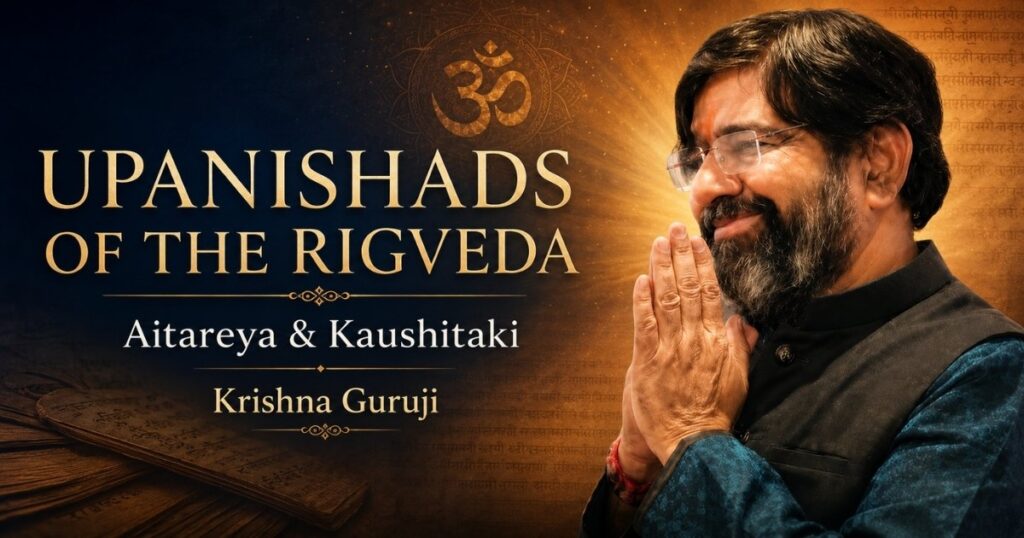
In this Hindi video, Krishna Guruji explains the Aitareya and Kaushitaki Upanishads in simple language:jiThe Upanishads of the Rigveda inspire us to look within ourselves. The Vedas contain mantras, prayers, and guidance for life, while the Upanishads encourage deeper reflection on consciousness, the Self and the purpose of human existence.
In this article, we will understand the two principal Upanishads associated with the Rigveda:
- Aitareya Upanishad
- Kaushitaki Upanishad, also known as the Shankhayana Upanishad
What Are the Upanishads?
The Upanishads are among the most important texts of Indian spiritual philosophy. They explore profound subjects such as Atma, Brahman, consciousness, Prana and the meaning of life.
Many Upanishads are presented as conversations between a Guruji and a disciple. The disciple places the deepest questions of life before the Guruji, who responds through wisdom, reflection, and spiritual experience.
The Vedas are the foundation of knowledge, while the Upanishads reveal the depth of that knowledge.
In simple terms, the Upanishads guide human beings towards self-understanding and inner awareness.
Two Principal Upanishads of the Rigveda
Two major Upanishads are traditionally associated with the Rigveda. The first is the Aitareya Upanishad, and the second is the Kaushitaki Upanishad.
The Kaushitaki Upanishad is also called the Kaushitaki Brahmana Upanishad. In some traditions, it is known as the Shankhayana Upanishad.
Both Upanishads raise important questions about human identity, consciousness, life and the force that keeps the body active.
Introduction to the Aitareya Upanishad
The Aitareya Upanishad is connected with the Aitareya Aranyaka of the Rigveda. It reflects on creation, consciousness and the true identity of a human being.
It encourages us to consider two fundamental questions:
- Who am I?
- How did creation come into existence?
First Question: Who Am I?
A person usually identifies with the physical body. However, the body does not remain the same throughout life. The body of childhood changes during youth and eventually enters old age.
Our thoughts, relationships and responsibilities also continue to change. Yet the inner experience of being “I” remains present.
A person performs many roles during life. He may be someone’s son, husband, father, friend, teacher or guide. These roles change, but the person performing them continues to exist.
The Example of an Actor in Ramlila
An actor may play the role of Lord Rama in one Ramlila performance. In another play, the same actor may portray Ravana.
The costume, character and dialogue change, but the actor behind those roles remains the same.
Similarly, the roles we perform in life keep changing. However, the consciousness experiencing these roles remains present within us.
A human being is not merely the physical body. The body is a medium through which life and consciousness are expressed.
Recognising this distinction is the beginning of self-reflection.
The Mahavakya of the Aitareya Upanishad
The celebrated Mahavakya associated with the Aitareya Upanishad is:
प्रज्ञानं ब्रह्म — Prajnanam Brahma
Its commonly understood meaning is: “Consciousness is Brahman.”
Here, Prajnana does not mean ordinary information or intellectual knowledge alone. It points towards awareness, understanding and the consciousness through which we experience existence.
Second Question: How Did Creation Begin?
The origin of creation is one of humanity’s oldest questions. The Aitareya Upanishad sees a conscious principle at the foundation of creation.
We can also examine this question through a modern perspective. Life in nature appears to develop continuously. A tiny seed gradually becomes a large tree. The tree produces flowers, fruits and new seeds, allowing the cycle of life to continue.
Seasons change, rain falls, rivers flow, old leaves fall and new leaves emerge. These processes operate according to the laws of nature.
Human Intelligence and Invention
Human needs have inspired countless inventions. The telephone, internet and modern medicine are clear examples. These developments are the result of human intelligence, curiosity, observation and experimentation.
Today, plants can even be cultivated in controlled environments. Through tissue culture, several plants may be produced from a small amount of biological material.
However, these methods still work by understanding and using biological principles. Humanity studies the laws of nature and learns how to apply them.
Ancient wisdom gives us profound questions, while human intelligence continues to discover new answers.
A Living Tree and Lifeless Wood
A living tree grows continuously. It absorbs water, produces new leaves, bears flowers and fruits, and creates new seeds.
Once wood is separated from the living tree, it normally does not continue those biological activities. This simple example helps us understand the difference between living activity and lifeless matter.
The Modern Message of the Aitareya Upanishad
The Aitareya Upanishad encourages us to ask whether we are only our bodies, names and social identities—or whether consciousness represents a deeper dimension of our existence.
It also views creation as a profound and organised process. Modern science continues to discover many of the principles governing that process.
Therefore, spirituality and science do not necessarily have to be treated as enemies. Both seek truth, although their approaches and methods may differ.
Introduction to the Kaushitaki Upanishad
The Kaushitaki Upanishad is another important Upanishad associated with the Rigveda. It is also called the Kaushitaki Brahmana Upanishad and, in some traditions, the Shankhayana Upanishad.
It reflects on Prana, consciousness, self-knowledge, and the force that sustains life.
The Central Question of the Kaushitaki Upanishad
An important question raised by this Upanishad is:
What is the fundamental force that keeps life active?
Our senses connect the body with the external world. The eyes see, the ears hear, and speech allows us to communicate. However, all these functions depend upon the presence of life.
The Upanishad connects this life-sustaining power with Prana.
What Is Prana?
It is not sufficient to understand Prana as breathing alone. Breath is considered an important expression of Prana, but Prana indicates the broader active force of life.
While life is present, the body performs its functions. When life ends, the physical activities of the body cease.
Prana is the active force of life, while consciousness gives meaning to human experience.
The Senses and Prana
Different senses perform different functions in the human body. However, without Prana, their independent presence has no practical value.
For this reason, the Kaushitaki Upanishad gives special importance to Prana. It encourages us to become more aware of life and breath.
Prana in Modern Life
Modern life is fast and demanding. People often remain occupied with work, responsibilities, and digital distractions while paying insufficient attention to sleep, food and breathing.
This imbalance may contribute to stress and restlessness. Pranayama can help us develop awareness of our breathing and may support mental calmness when practised correctly.
Anyone with a medical condition should practise yoga or Pranayama only according to appropriate professional guidance.
Difference Between the Aitareya and Kaushitaki Upanishads
| Aitareya Upanishad | Kaushitaki Upanishad |
|---|---|
| Reflects on the true identity of a human being | Reflects on Prana and the life force |
| Raises questions about the origin of creation | Explores the relationship between Prana and consciousness |
| Presents the Mahavakya “Prajnanam Brahma” | Highlights the importance of Prana in life |
| Asks, “Who am I?” | Asks, “What keeps life active?” |
The Combined Message of Both Upanishads
The Aitareya Upanishad inspires us to recognise consciousness and examine our true identity. The Kaushitaki Upanishad inspires us to understand Prana and the force that sustains life.
One asks who a human being truly is. The other asks what power keeps life active. Together, they offer a path towards understanding life from within.
Watch the Video: Upanishads of the Rigveda
In this Hindi video, Krishna Guruji explains the Aitareya and Kaushitaki Upanishads in simple language:
Watch the complete video on YouTube
Relevance of the Rigveda Upanishads Today
Human life and technology continue to change with time. Therefore, ancient wisdom should also be interpreted through open dialogue, observation and reason.
Ancient scriptures do not describe every modern invention. However, they encourage humanity to ask fundamental questions.
Today’s younger generation wants to understand spirituality through evidence, logic and personal experience. The Upanishads can therefore be studied with curiosity rather than fear or blind acceptance.
The Vedas give us a direction for thinking; they do not place a boundary around human thought.
Krishna Guruji’s Message
Human needs keep the journey of invention moving forward. Through intelligence, wisdom, and experimentation, humanity continues to make new discoveries.
Knowledge cannot be limited to a single age. There should be a meaningful dialogue between ancient spiritual thought and modern science.
We can search for new answers to ancient questions while continuing to respect nature, humanity and life.
“Life is yours; the suggestion is mine.” — Krishna Guruji
Conclusion
The Upanishads of the Rigveda encourage reflection on the Self, consciousness, creation and the power of life.
The Aitareya Upanishad raises questions about human identity and consciousness. The Kaushitaki Upanishad explains the importance of Prana and the active force of life.
The purpose of these teachings is not merely to provide information. Their deeper purpose is to awaken curiosity and awareness within every human being.
When we begin to understand ourselves, our perspective towards life starts changing. This self-reflection marks the beginning of the true journey of knowledge.
Read the original Hindi article:
ऋग्वेद के उपनिषद: ऐतरेय और कौषीतकि
Continue your journey through Vedic wisdom:
Upanishads of the Samaveda: Kena and Chandogya
Upanishads of the Atharvaveda: Om and the Four States of Consciousness
Upanishads of the Yajurveda: Is Death an End or a New Beginning?
Explore more spiritual and Vedic articles at
KrishnaGuruji.com.