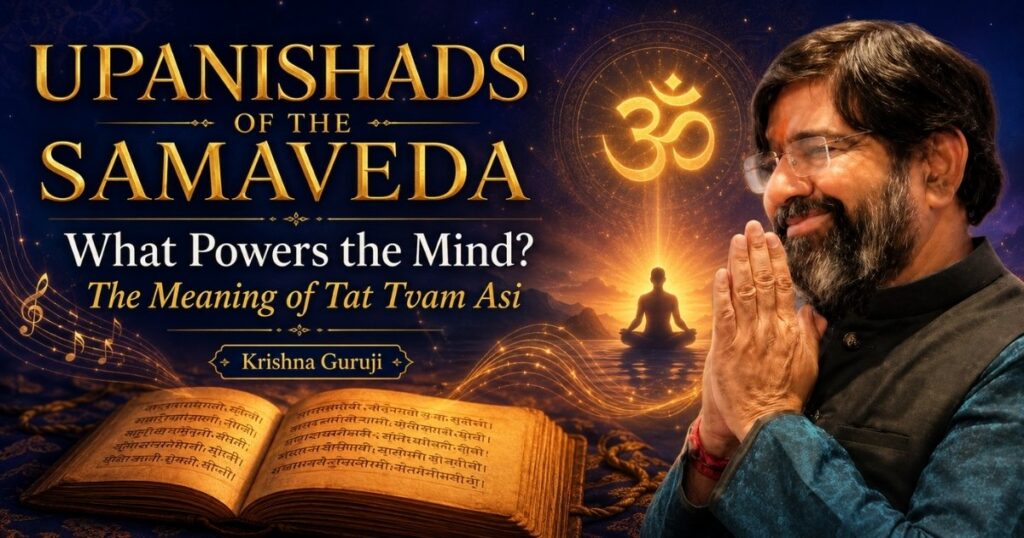
How can the mind travel thousands of miles within a moment? Our eyes see, our ears hear, and our speech expresses ideas. However, what gives these faculties their power?
The Upanishads of the Samaveda explore these profound questions. In particular, the Kena Upanishad examines the source of consciousness. Meanwhile, the Chandogya Upanishad reveals the meaning of “Tat Tvam Asi.”
The Rigveda gave us sacred hymns. The Yajurveda connected those hymns with rituals and action. In contrast, the Samaveda gave them melody, rhythm, and sacred chanting.
Therefore, the Upanishads linked with the Samaveda guide us from sacred sound towards inner consciousness.
Understand the Upanishads of the Samaveda Through Video
In this video, Krishna Guruji explains the Kena and Chandogya Upanishads in simple language. He also explores the mind, consciousness, Brahman, and Tat Tvam Asi.
Watch the Samaveda Upanishads video directly on YouTube.
You may also read the original Hindi article: सामवेद के उपनिषद: मन को शक्ति कौन देता है?
Which Are the Major Upanishads of the Samaveda?
The Kena Upanishad and Chandogya Upanishad hold an important place in the Samaveda tradition. Both explore consciousness, Brahman, and the true nature of the Self.
The Kena Upanishad asks what power works behind the mind and senses. On the other hand, the Chandogya Upanishad introduces us to our inner reality.
For authenticated references, readers may explore the Government of India’s Vedic Heritage Portal section on the Samaveda.
What Is the First Question of the Kena Upanishad?
What gives the mind the power to think?
The body needs food to perform its functions. Similarly, the body and brain require sleep and rest.
However, food and sleep do not fully explain consciousness. Even when the body rests, the mind can remain active.
The mind may reach our home within a moment. Next, it may imagine another city or country. It can also revisit the past and imagine the future.
Therefore, the Kena Upanishad asks a deeper question. What is the power that moves the mind?
The Simple Answer of the Kena Upanishad
According to the Kena Upanishad, a fundamental consciousness works behind the mind. Because of that consciousness, the mind can think.
The same consciousness enables the eyes to see. It also allows the ears to hear and speech to express ideas.
Nevertheless, consciousness itself cannot become an ordinary object of the senses. The Upanishad identifies the ultimate foundation as Brahman.
Readers can study the source through the Kena Upanishad section of the Vedic Heritage Portal.
A Simple Example for Understanding Consciousness
A device cannot work without a source of power. Once it receives power, its different functions become active.
Similarly, the body acts as a medium for experience. Consciousness allows life, thought, and awareness to appear through it.
However, this is only a simple example. We should not treat the Atman as a physical battery or material object.
Difference Between Mind, Intellect, Discernment, and Consciousness
Mind, intellect, discernment, and consciousness do not perform the same functions. Therefore, we should understand them separately.
- Mind: Thoughts, desires, memories, and imagination arise within the mind.
- Intellect: The intellect examines situations and makes decisions.
- Discernment: Discernment distinguishes between helpful and harmful choices.
- Consciousness: Consciousness witnesses our thoughts and experiences.
- Prana: Prana supports the subtle life processes of the body.
We cannot always prevent thoughts from appearing. However, intellect and discernment can decide which thoughts deserve attention.
Krishna Guruji’s Observe, Filter, and Surrender Formula
Krishna Guruji offers a practical method for handling thoughts. It has three simple steps:
- Observe: First, notice the thought without fear or immediate reaction.
- Filter: Next, examine its value through intellect and discernment.
- Surrender: Finally, release thoughts that are negative or unhelpful.
We can close our eyes and cover our ears. However, we cannot stop thoughts in the same manner.
Therefore, we do not need to fight every thought. Instead, we should guide our thoughts in a constructive direction.
Turn a positive thought into meaningful action. Meanwhile, surrender a harmful thought before it controls your behaviour.
Are Consciousness, Prana, and Atman the Same?
People often use these terms with similar meanings. However, traditional study may explain them through different functions.
Prana supports the life processes of the body. In contrast, the mind remains the field of thoughts and desires.
Atman refers to the witnessing Self or inner consciousness. Therefore, the light of consciousness enables the mind to function.
At the same time, Prana supports the living processes of the body. This balanced understanding prevents unnecessary confusion.
What Does Tat Tvam Asi Mean?
Tat Tvam Asi — You Are That.
This Mahavakya appears in the Chandogya Upanishad. It forms part of the dialogue between Uddalaka and his son Shvetaketu.
Our true identity is greater than our name, profession, position, or body. However, we often define ourselves through these temporary identities.
A person may connect identity with family, property, and social status. Yet all these appear small before the vast universe.
On the other hand, Tat Tvam Asi reminds a discouraged person of inner strength. It points towards the consciousness present within every being.
Readers may explore the Chandogya Upanishad on the Vedic Heritage Portal.
Does Tat Tvam Asi Mean “I Alone Am God”?
We should not turn Tat Tvam Asi into a declaration of ego. Its purpose is not to make a person proud.
Instead, it reveals a relationship between individual consciousness and ultimate reality. Therefore, every living being deserves respect.
When we recognise consciousness within ourselves, we also begin to honour it in others. As a result, discrimination and hostility decrease.
Should We Search for God Outside or Within?
Temples, pilgrimages, and sacred places remain important centres of devotion. They help the mind become focused and prayerful.
However, the Upanishads also invite us to look within. We can quietly observe our breath, thoughts, and awareness.
Close your eyes, connect with your breath, and experience the consciousness present within your heart.
This inner journey does not reject external worship. Instead, it adds self-awareness to our devotion.
Why Are the Upanishads of the Samaveda Relevant Today?
Modern life gives us endless information. However, many people still experience stress, confusion, and inner unrest.
The Kena Upanishad encourages us to examine the source of thought. Meanwhile, the Chandogya Upanishad inspires self-respect and self-knowledge.
Therefore, we can apply these teachings in everyday life:
- Do not accept every thought as an absolute truth.
- Use discernment before making an important decision.
- Do not give unnecessary strength to negative thoughts.
- Trust the consciousness and ability present within you.
- Respect the same inner dignity within every person.
Explore the Vedas and Upanishads Series
To understand the background of this tradition, read the Hindi summary of the Samaveda.
You can also continue the English Upanishad series:
- Upanishads of the Rigveda: Aitareya and Kaushitaki
- Is Death an End or a New Beginning? Upanishads of the Yajurveda
Conclusion
The Upanishads of the Samaveda give us two essential teachings. The first teaching comes from the Kena Upanishad.
A fundamental consciousness works behind the mind. Therefore, the mind alone cannot represent the final truth.
The second teaching comes from the Chandogya Upanishad. Tat Tvam Asi guides us towards our deeper identity.
Thoughts will naturally arise. However, discernment can give them the right direction.
Through Observe, Filter, and Surrender, we can understand the mind more clearly. We can also reduce the power of harmful thoughts.
An outer journey shows us the world. In contrast, an inner journey introduces us to ourselves.
Your life, my suggestion — Jivan Aapka, Sujhav Mera.
Frequently Asked Questions
Which are the major Upanishads of the Samaveda?
The Kena Upanishad and Chandogya Upanishad are among the major Upanishads linked with the Samaveda.
What is the central question of the Kena Upanishad?
It asks what power directs the mind, speech, Prana, hearing, and sight.
What is the simple meaning of Tat Tvam Asi?
Tat Tvam Asi means “You Are That.” It points towards the relationship between the Self and ultimate reality.
What is the difference between mind and intellect?
The mind produces thoughts and desires. In contrast, the intellect examines those thoughts and makes decisions.
How can we handle negative thoughts?
First, observe the thought. Next, filter it through discernment. Finally, surrender it when it offers no constructive value.
— Krishna Guruji
Spiritual Mentor, Yoga Teacher and Humanitarian