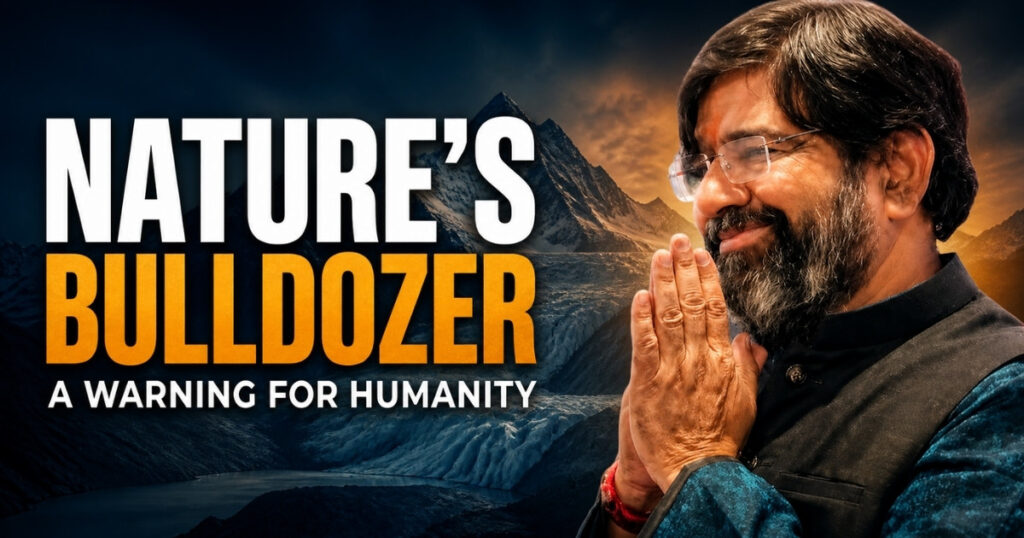
My heart is deeply troubled. The devastating flood on the Nepal–Tibet border has claimed many lives.
I offer my heartfelt tribute to every person who lost their life in this tragedy.
They too must have begun their journeys with dreams in their eyes. Some were returning to their families. Some were on a pilgrimage. Others were working to secure a better future for their children.
But this sudden disaster changed everything.
What was their fault?
It is difficult to imagine the pain of the families who lost their loved ones. My deepest sympathies are with every grieving family.
I also pray for those who are injured or missing. At this moment, helping the victims is humanity’s foremost duty.
We Had Not Yet Recovered from the Warning at Amarnath
We had not yet come to terms with the unusually rapid melting of Baba Amarnath’s natural ice lingam when the Himalayas showed us another terrifying event.
The 2026 Amarnath Yatra began on July 3 and was scheduled to formally conclude on August 28, on Raksha Bandhan. Yet the natural ice lingam melted by more than 90 percent within just a few days.
In other words, it had almost disappeared nearly 52 days before the scheduled conclusion of the pilgrimage.
The yatra was later suspended early because of weather warnings and a decline in pilgrim numbers, although the tradition of Chhari Mubarak remained scheduled for August 28.
For us, Amarnath is not merely a natural formation of ice. Baba Amarnath is a centre of faith and spiritual consciousness for millions of devotees.
This event is therefore deeply distressing from religious, spiritual, and environmental perspectives.
The formation and melting of the ice lingam are natural processes. Even so, such rapid melting raises unusual concern.
Rising temperatures, reduced snowfall, and changing rainfall patterns were considered possible causes. You may also read our earlier article, Baba Amarnath Melting Early: Nature’s Warning.
A scientific and environmental analysis of the rapid melting is also available in NDTV’s detailed report.
Glacier and Rock Collapse on the Nepal–Tibet Border
Before we could fully understand the warning from Amarnath, a massive section of glacier and rock collapsed on the Nepal–Tibet border.
The event occurred at an altitude of about 5,200 metres. Ice and rock fell into the valley, creating a powerful flow of water, ice, mud, and stones.
The debris was estimated to be moving at nearly 50 metres per second—about 180 kilometres per hour—leaving people with very little time to react.
The violent flow affected settlements and the border trade area. Roads, bridges, and power projects were also caught in its path.
In addition, the river’s form changed for more than 100 kilometres downstream.
Maps and satellite images of the event can be seen in Reuters’ detailed report.
Did Construction Alone Cause the Glacier to Collapse?
This question must be answered responsibly. It would not be right to identify any single bridge, project, or settlement as the direct cause.
A scientific investigation into the exact causes of the event is still underway.
However, rising temperatures can weaken the natural bonds between ice and rock. Thawing permafrost can also destabilise mountain slopes.
At the same time, increasing construction in fragile valleys certainly increases the risk of human loss.
Roads, hotels, bridges, and power projects are reaching ever closer to sensitive natural areas.
There was no permanent population at the glacier’s point of origin in this recent event, but residential and commercial activity existed about 20 kilometres downstream.
That is why the disaster directly affected human settlements.
It must also be made clear that the people living there were not at fault. They were innocent, and our sympathies are with them.
Policy-makers, however, must establish safe limits for construction.
Nature Needs Its Own Space
Human beings need space for their homes and lives. In the same way, nature needs room to flow, expand, and remain alive.
A river’s floodplain is the river’s own space. A mountain slope is its natural foundation. Likewise, the valley below a glacier is a potential route for water and debris.
Protecting these natural zones is not a sign of backwardness. It is evidence of scientific understanding and foresight.
“Give nature its space. Otherwise, nature will create that space for itself.”
—Krishna Guruji
If human beings occupy every place that belongs to nature, nature will eventually reclaim it.
When that happens, nature’s bulldozer will not distinguish between a road, bridge, hotel, building, or border.
Nature’s Bulldozer Is a Warning for Policies, Not for Victims
The expression “nature’s bulldozer” is not meant to blame victims. Those who died in the natural disaster were innocent.
Compassion and assistance for them are our first responsibilities.
This warning is directed at our collective policies. It questions unlimited greed and neglect of the environment.
It also asks us to consider the consequences of construction undertaken without scientific balance.
Nature does not choose to punish an individual. It follows the eternal law of cause and effect.
Therefore, when the natural balance is disturbed, human life will inevitably feel the consequences.
I Am Not Opposed to Development
Roads, bridges, electricity, housing, and communication are essential for human life. I am not opposed to development.
But a balance between development and environmental protection is essential.
A development model designed for the plains cannot be imposed on a fragile region such as the Himalayas.
Every major project should be preceded by an independent environmental study.
Scientific risk maps must be prepared for glaciers and river zones, while landslide and debris-flow paths should be clearly marked.
Clear limits on construction should be established in hazardous areas, and modern early-warning systems should be installed.
Local residents, pilgrims, and tourists should also receive disaster-preparedness training.
The Vedas Taught Us to Protect Nature
Our Vedas recognised divinity in earth, water, fire, air, and space.
The true message is one of respect and gratitude toward nature.
Worship of the five great elements becomes meaningful only when we protect them as well.
To understand this Vedic message in greater depth, read The Essence of the Yajurveda and Environmental Protection.
“The Vedas taught us to protect nature, but we abandoned protection and began consuming nature.”
—Krishna Guruji
Merely taking from nature is not the Vedic way of life. We must also fulfil our duty toward nature.
Saving water, planting trees, and keeping rivers clean are the modern forms of yajna.
More of Krishna Guruji’s thoughts on the environment can be found in Electric Cremation and Environmental Conservation.
A Clear Warning for Humanity
The early melting of the Amarnath ice lingam was a warning.
The Nepal–Tibet tragedy revealed a more destructive expression of nature’s power.
Humanity must now awaken. If environmental imbalance continues, the risk of such events will keep increasing.
Innocent people and future generations will pay the price for our mistakes.
- Pursue development—but with wisdom.
- Use nature—but do not exploit it.
- Build—but within nature’s limits.
- Undertake pilgrimages—but preserve the sanctity of the environment.
Development is necessary, and so is the protection of nature. We must create a scientific, humane, and spiritual balance between the two.
Give nature its space. If you encroach upon nature, one day nature’s bulldozer will surely strike.
—Krishna Guruji
Spiritual Thinker and Humanitarian
Your pledge: From today, resolve to protect one element of nature. Plant a sapling and care for it. Save water, and behave responsibly in environmentally sensitive areas.
For more messages from Krishna Guruji on spirituality, the Vedas, the environment, and service to humanity, read the latest articles on KrishnaGuruji.com.