My Dream After Death: Let the Earth Remain Green, So My Last Rites Be Performed at an Electric Crematorium
A Personal Commitment to Environmental Conservation and Time-Relevant Thinking
Author: Krishnakant Mishra “Krishna Guruji.” This article explores the important relationship between Electric Cremation Environmental Conservation and sustainability for the future.
Does a person only dream while alive? Can there not be a dream for what comes after death? Electric cremation environmental conservation is an idea that inspires my wishes after passing.
I, too, have a dream—a dream about what happens after my life ends. My hope centers around electric cremation environmental conservation and its far-reaching impact.
I wish future generations to inherit a green and flourishing Earth. I want the environment to remain clean and balanced. I want trees to be protected, rivers to flow pure, and nature to continue smiling forever.
With this thought, I have already expressed my wish to my family: after my passing, my last rites should be performed in an electric crematorium. I do not wish for traditional wood-based cremation since electric cremation environmental conservation aligns with my beliefs.
This decision is not an opposition to any tradition or faith. Rather, it reflects my personal commitment to environmental conservation. I believe that, with changing times, it is important to reflect upon certain social customs and embrace positive changes that serve the greater good of society. For many, choosing electric cremation environmental conservation is one such positive change.
The Eternal Message of Sanatan Dharma: Respect for Nature
The Vedas of Sanatan Dharma, especially the Rigveda, regard nature as divine. Rivers, mountains, and trees have therefore been revered and worshipped. Our sages did not see nature merely as a resource; they considered it the very foundation of life.
In ancient times, the population was much smaller, and forest resources were abundant. Moreover, modern facilities such as electric crematoriums did not exist. Today, circumstances have changed, and considering environmentally friendly alternatives appears to be the need of the hour.
What Did the COVID-19 Pandemic Teach Us?
The difficult days of the COVID-19 pandemic are still fresh in our memories. During that time, many families could not even have a final glimpse of their loved ones.
In several places, circumstances necessitated collective and rapid cremations.
Human life and safety became the highest priorities, and society accepted many practical changes. Making decisions according to the situation was essential.
This naturally raises an important question: if we can adopt practical changes during times of crisis, why can we not thoughtfully consider positive alternatives for environmental conservation during normal times?
A Commitment to Service Instead of Ritual Feasts
I have made another request to my family: after my death, no death feast or ceremonial meal should be organized in my name.
Instead, those resources could be used for tree plantation. Supporting cow welfare is another meaningful option. One could contribute to education, healthcare, or assist those in need. Such efforts would benefit both society and nature.
Change Begins with Ourselves
Major social changes always begin with individuals. Therefore, I have tried to initiate this commitment in my own life.
If this small step inspires even a few people to think about environmental conservation, I would consider it one of the greatest achievements of my life.
🌳 A Thought for Society 🌳
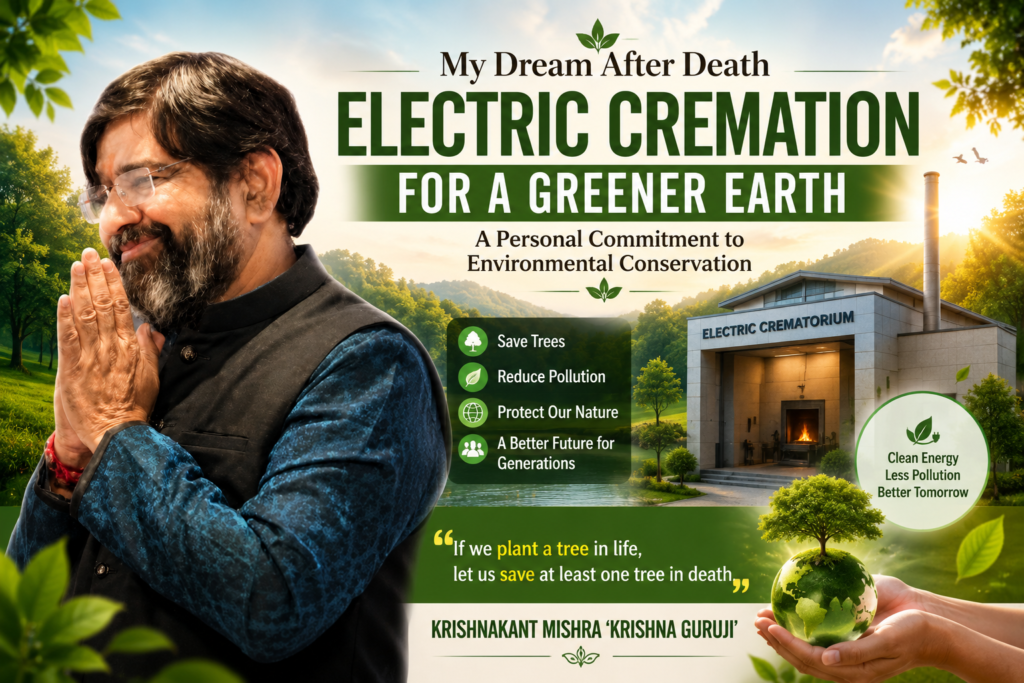
If we plant a tree during our lifetime, perhaps we can also pledge to save at least one tree after our death.
Today, modern electric crematoriums are available. Those who voluntarily choose this environmentally friendly option can contribute to building a greener and cleaner Earth for future generations.
My thoughts are not intended to oppose any tradition or religious belief. Rather, they represent a personal commitment to protecting nature and encouraging constructive social dialogue. Every individual and family has the complete right to make decisions according to their faith and circumstances.
Sanatan culture teaches us to respect, protect, and live in harmony with nature. Therefore, reflecting upon environmentally responsible alternatives in accordance with changing times may also be our collective responsibility.
“Does a person only dream while alive? My dream is about what comes after my death. I want my Earth to remain green, trees to stay protected, and nature to continue smiling.”
Your life, my humble suggestion.
— Krishnakant Mishra “Krishna Guruji” 🌿🙏