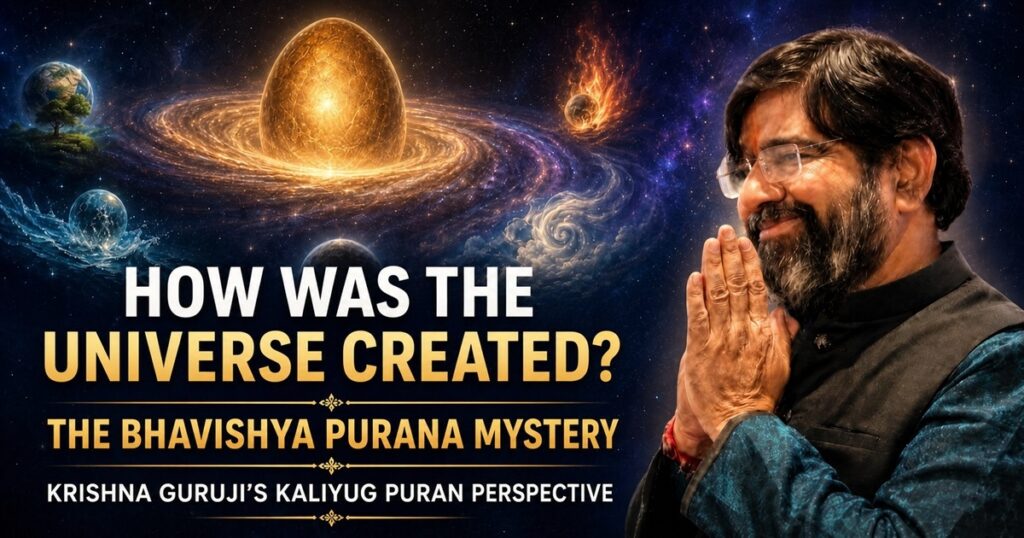
How was the universe created? Did creation begin with fire, water, darkness, or the five elements? What existed before Earth, the Sun, and the Moon appeared?
This is the English version of our Hindi article. Read the original Hindi version here.
These questions belong to humanity’s oldest search for knowledge. Science studies the physical origin of the cosmos. Meanwhile, the Vedas and Puranas explore its spiritual meaning.
Krishna Guruji explains creation in the Bhavishya Purana through clear language and the practical perspective of Kaliyug Puran.
Questions to Consider Before Reading
- Did creation begin with light or darkness?
- Were time and space present before the visible universe?
- Are animals, plants, rivers, and mountains part of Divine Creation?
- Did the universe arise once, or does creation repeat in cycles?
Pause and consider your answers. Therefore, knowledge becomes a personal search instead of an unexamined belief.
Who Narrates the Bhavishya Purana?
The Bhavishya Purana begins with a dialogue between King Shatanika and Maharishi Sumantu. The king seeks knowledge about dharma, life, and creation. Maharishi Vedavyasa directs his disciple Sumantu to share the Purana. Thus, Sumantu answers the king’s questions.
A Purana traditionally presents five themes:
- Sarga: the original emergence of creation.
- Pratisarga: recreation after dissolution.
- Vamsha: lineages of deities, sages, and kings.
- Manvantara: vast cycles of cosmic time.
- Vamshanucharita: stories of different lineages.
Consequently, creation is not an isolated event. It forms a cycle of emergence, preservation, change, dissolution, and renewal.
What Existed Before Creation?
The Brahma Parva describes an unmanifest and dark state at the beginning. Nothing appeared in a recognizable form. Moreover, ordinary intellect could not fully grasp that condition.
This darkness means more than the absence of light. It points to an unmanifest state in which names, forms, and separate objects had not appeared. Earth had no present form. Mountains, rivers, the Sun, the Moon, and living beings were also absent.
However, absence of visible creation does not mean absolute nothingness. In addition, spiritual tradition speaks of an eternal, subtle consciousness beyond the senses.
The Appearance of Divine Consciousness
The Bhavishya Purana describes a supreme reality that pervades all beings. We should not limit the Divine to a human-like figure in the sky. Instead, we may understand the Divine as the consciousness, energy, and order behind the cosmos.
Ancient people observed lightning, rain, fire, wind, and sunlight with wonder. Therefore, sages used symbols and divine forms to explain these experiences. The symbols helped people respect nature and recognize sacred order.
Hiranyagarbha: The Golden Cosmic Seed
From the unmanifest state emerged Hiranyagarbha, the golden cosmic womb or seed. It represents the first concentrated possibility of creation. Just as a seed contains the potential of a tree, Hiranyagarbha contains the possibility of the universe.
Afterward, space, directions, time, the five elements, planets, rivers, mountains, plants, animals, and human life gradually appeared. This sequence offers a spiritual image of ordered expansion.
We should not treat the account as a modern laboratory theory. Rather, it presents a symbolic framework for understanding unity, order, and responsibility.
The Five Elements and Cosmic Creation
Sanatan thought connects the universe and the human body with earth, water, fire, air, and space.
- Earth represents stability and physical form.
- Water represents flow, nourishment, and adaptability.
- Fire represents energy, light, and transformation.
- Air represents breath and movement.
- Space provides room for every form and experience.
Because our bodies depend on these elements, protecting nature becomes a spiritual duty. For example, clean air supports breath, while clean water sustains life. Likewise, fertile soil provides food and sunlight supplies energy.
Creation as a Continuous Cycle
The Puranic view does not describe creation as a single event. Instead, it presents recurring cycles of creation, preservation, transformation, dissolution, and recreation.
We observe similar patterns everywhere. A day begins and ends. Seasons change and return. A seed becomes a tree, and the tree produces more seeds. Likewise, human ideas arise, develop, change, and begin again.
Therefore, dissolution does not always mean destruction without purpose. It can prepare space for renewal.
What Is Humanity’s Duty Within Creation?
The most important question is not only how the universe began. We must also ask what we should do as a small part of this vast creation.
If the same five elements support every human, animal, plant, river, and mountain, then exploitation harms the larger family of life. Consequently, spiritual knowledge should lead to compassion and responsible action.
“I have not come to connect you only with me. I have come to connect you with yourself and with the five elements.” —Krishna Guruji
Five Simple Practices of Gratitude
- Thank the air: Observe your breath and feel grateful for life.
- Honor the Earth: Touch the ground respectfully before beginning your day.
- Respect water: Use water carefully and avoid waste.
- Welcome sunlight: Offer gratitude for warmth, light, and energy.
- Connect with space: Look at the open sky and let your thoughts expand.
These practices require no difficult ritual. Nevertheless, they can transform ordinary moments into mindful living.
A Simple Five-Element Meditation
Sit comfortably and close your eyes. First, notice the Earth supporting your body. Next, observe the natural movement of your breath.
Then remember a peaceful river, rainfall, or ocean. Feel the warmth of sunlight and the inner fire that supports life. Finally, imagine the open sky and experience spaciousness.
Silently affirm: “I arise from the five elements. With gratitude, I respect them. I will protect my body, humanity, and nature. Finally, I will share love and fulfill my duty.”
Take one long breath. Afterward, open your eyes gently and drink water with gratitude.
What Can We Learn Today?
The Bhavishya Purana presents the early universe as unmanifest and dark. Then the creative resolve of supreme consciousness brings forth Hiranyagarbha. From this cosmic seed emerge space, time, the five elements, planets, rivers, mountains, vegetation, and living beings.
Furthermore, creation continues as a cycle rather than a one-time event. This teaching asks us to respect every human, protect every living being, preserve the five elements, share useful knowledge, and create something good each day.
When awareness removes the darkness of ignorance, a new creation also begins within our lives.
The Kaliyug Puran Perspective
Kaliyug Puran connects ancient spiritual symbols with questions asked by today’s youth. It encourages sincere inquiry, meditation, service, and care for nature.
Explore more articles on the Krishna Guruji Blog.
About the Author
Krishna Guruji (Krishna Kant Mishra) is a spiritual thinker, humanitarian, and author of Kaliyug Puran. He explains ancient wisdom through simple logic, meditation, service, and environmental responsibility.