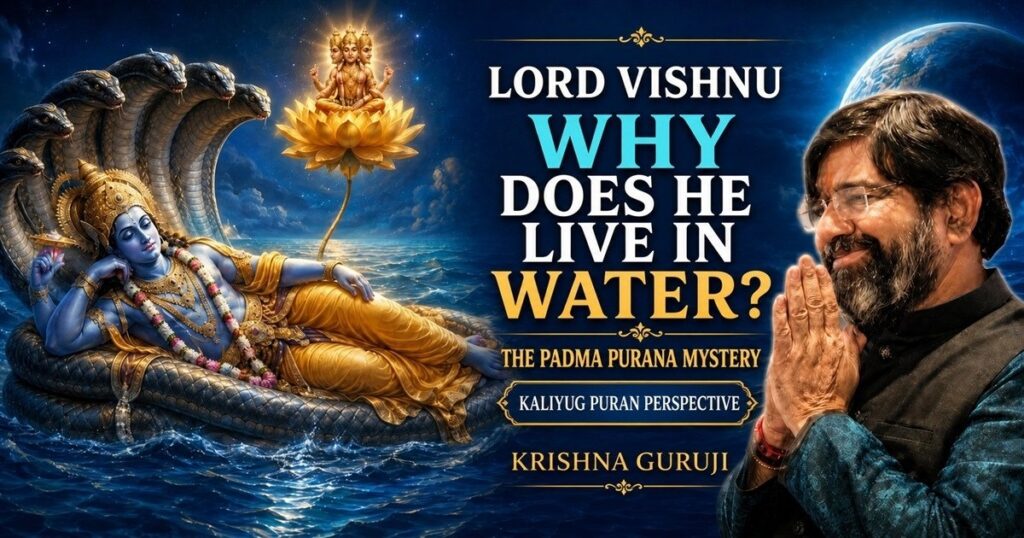
Why does Lord Vishnu live in water? A lotus emerges from His navel—but why is Lord Brahma seated upon it?
What does the name Padmanabha mean, and what is the deeper meaning of Sheshnag beside Him?
This is the English version of our Hindi article. Read the original Hindi version here.
Our journey through the Puranas has now reached the Padma Purana. Earlier, we reflected on the origin of creation. Here, we explore the connected processes of creation, preservation, and transformation.
Moreover, this article does more than retell a traditional story. It connects scriptural imagery with modern symbols while keeping classical references and personal interpretation clearly separate.
Author: Krishna Guruji—spiritual thinker, humanitarian, and creator of Kaliyug Puran.
Watch the Video: Padma Purana and the Mystery of Lord Vishnu
Watch the complete explanation on YouTube: Why Does Lord Vishnu Live in Water?
What Is the Padma Purana?
The Padma Purana is one of the eighteen Mahapuranas of the Sanatan tradition. It is an extensive religious and cultural scripture covering creation, the Earth, sacred places, dharma, devotion, and liberation. Different recensions contain variations, yet the lotus and the appearance of Brahma remain central symbols; this is why it is known as the Padma Purana.
In the Srishti Khanda, Brahma praises Vishnu and describes his birth in the lotus that emerged from Vishnu’s navel. This scriptural passage may be read in the Srishti Khanda of the Padma Purana. Elsewhere, the cosmic lotus is described as Earth-like, with its divisions symbolically connected to mountains and geography.
What Does Padma Mean?
“Padma” means lotus. A lotus gradually opens each petal. In the same way, creation expands from possibility into visible form. A seed becomes a great tree, and that tree produces new seeds; the cycle of creation continues.
In addition, the lotus is rooted in mud, yet its flower remains clean and beautiful. It therefore symbolizes pure growth amid difficult circumstances.
“Although the lotus is born in mud, it is not defined by the mud. A human being, too, is known by the purity of character.”
What Is the Real Meaning of Padmanabha?
The word “Padmanabha” combines padma, meaning lotus, and nabhi, meaning navel: the One from whose navel the lotus appeared. Brahma sits on that lotus, so the lotus becomes a symbol of creation manifesting from its sustaining source.
Vishnu is the foundation, the lotus is the medium of expansion, and Brahma is the active power of creation. This also teaches that creation cannot survive without preservation. The birth of a child is creation; providing love, values, and protection is preservation. Building a house is creation; maintaining it with care is Vishnu-tattva.
Why Does Lord Vishnu Live in Water?
Tradition regards Lord Vishnu as the preserver of creation. Likewise, water forms a fundamental basis of life. Without water, vegetation, food, and living organisms cannot survive. Water is therefore far more than a means of satisfying thirst.
NASA explains that water covers about 71 percent of Earth’s surface. USGS notes that water may make up about 60 percent of an adult human body, although the proportion varies with age, sex, and body composition.
From the Kaliyug Puran perspective, Vishnu’s presence in water carries a profound message: water supports and preserves life. Protecting water and nature can therefore become a practical expression of Vishnu-tattva.
How Is the Word Narayana Connected with Water?
In a traditional explanation, scholars associate “nara” with water, while “ayana” means refuge or abode. Narayana may therefore be understood as the One whose abode is in the waters. However, the spiritual meaning is broader. Narayana forms the foundation of all beings, and the whole universe finds refuge in Him.
The Symbolic Meaning of Kshirsagar
Artists depict Lord Vishnu not in an ordinary ocean but in Kshirsagar, the Ocean of Milk. Milk symbolizes nourishment; a mother’s milk sustains a child at the beginning of life. Kshirsagar may therefore represent the infinite possibility of nourishment and preservation.
Vishnu rests there in Yoga Nidra. This is not carelessness or unconscious sleep, but calm awareness. Preservation does not arise from panic; it requires peace, balance, and alertness.
Brahma-Tattva: The Creative Power Within the Human Body
Consider the mythological image in relation to the human body. Below the navel lie the abdominal and reproductive regions. New life enters the world through the reproductive system, which is part of nature’s creative arrangement.
This does not mean that the navel and reproductive organs are the same. The connection is symbolic. Kaliyug Puran views the lower region of the body as a field of creation. In this sense, Brahma represents the Generator within us—the power that gives birth to new life, ideas, and possibilities.
Vishnu-Tattva: Preservation in the Heart
The heart and lungs are in the middle region of the body. The heart circulates blood, while the lungs enable the exchange of oxygen. The chest is therefore deeply connected with sustaining life.
A mother holds her child close to her chest, offering love, nourishment, warmth, and protection. The heart naturally becomes a symbol of love and care. Whenever we keep a family united, protect a living being, or responsibly maintain what has been created, Vishnu-tattva is active. Vishnu is the Operator within us—the power that sustains and guides life.
What Is the Mystery of Sheshnag?
Another name for Sheshnag is Ananta, meaning endless. He symbolizes infinite time and cosmic continuity. Everything that is born must change, and one day its present form will end.
Snakes do not have movable eyelids, so their eyes appear open even during rest. They can also sense vibrations and chemical signals, and some species detect heat. More details are available from the Smithsonian’s National Zoo.
In the Kaliyug Puran interpretation, Sheshnag symbolizes time, protection, and constant vigilance. Vishnu may appear peacefully absorbed in Yoga Nidra, yet the system of preservation remains fully alert.
Ajna Chakra and the Shiva-Tattva Within
Yogic tradition places the Ajna Chakra between the eyebrows and connects it with discernment and inner vision. Shiva’s third eye symbolizes the ending of ignorance and negativity.
We should not describe anger as a scientific activation of the Ajna Chakra; this is a spiritual and yogic symbol. Ending a harmful habit, ego, or ignorance is also a form of destruction. Only then can positive reconstruction begin. Shiva is therefore both Destroyer and Transformer.
However, we should not directly identify Sheshnag as Shiva. Yet the symbol of infinite time reminds us of Shiva’s transformative principle. Read more in The Mystery of Mahakal’s Bhasma Aarti.
GOD: Generator, Operator, and Destroyer
Young people can remember the three powers through a simple modern formula:
- G—Generator: Brahma’s power of creation.
- O—Operator: Vishnu’s power of preservation and operation.
- D—Destroyer: Shiva’s power of transformation and renewal.
This is not the historical origin of the English word “God.” It is only a modern memory device for understanding three spiritual functions.
When a new idea arises within us, we experience Brahma-tattva. Next, nurturing and sustaining that idea activates Vishnu-tattva. Finally, removing its weaknesses allows Shiva-tattva to open the path of transformation.
The Five-Element Connection Between Body and Cosmos
Sanatan thought connects both body and universe with the five elements: earth, water, fire, air, and space. Ayurveda similarly emphasizes the balance of vata, pitta, and kapha, though these should not be confused with scientific weather models.
The message of balance remains valuable. Bodily imbalance can affect health, while exploitation of nature can deepen environmental crises. For example, we receive oxygen and resources from trees. Therefore, planting and caring for trees is our responsibility. Similarly, rivers provide our water, so we must protect them from pollution.
“Taking from nature without returning anything is exploitation. Receiving and giving back is nourishment and karma yoga.”
A Simple Narayana Meditation
Sit comfortably and close your eyes. Take one long, natural breath. Imagine yourself on a calm seashore, watching waves rise and dissolve.
At first, a wave appears separate. Then it merges back into the ocean. In the same way, individual life remains part of the vast creation.
Bring your awareness to the navel and honor your inner creative power. Then focus on the center of the chest and feel the power of love and preservation. Finally, bring awareness to the Ajna Chakra and resolve to release negativity through discernment.
Silently repeat: “Narayana is in you, Narayana is in me; wherever I look, there is Narayana.” Slowly open your eyes and drink a glass of water with gratitude.
Learn to Be Like Water
Water takes the shape of every vessel while retaining its essential nature. When it joins the Ganga, it is called Gangajal; when offered at the Divine feet, it becomes Charanamrit. Adapt to circumstances, but do not abandon your good values.
Why Lord Vishnu Lives in Water: A Short Answer
- The lotus of the Padma Purana symbolizes the expansion of creation.
- Padmanabha means the One from whose navel the lotus emerged.
- Brahma on the lotus represents creative power.
- Water is a basic requirement for life and preservation.
- Kshirsagar symbolizes nourishment and calm awareness.
- Sheshnag represents infinite time, protection, and vigilance.
- Vishnu-tattva teaches love, protection, and responsible stewardship.
- Shiva-tattva inspires renewal by removing negativity.
The Relevance of the Kaliyug Puran Perspective
Kaliyug Puran does not seek to reject the Puranas or traditions. Its purpose is to communicate their symbols to today’s questioning and rational young minds.
Questioning with faith is not opposition. A sincere question can deepen understanding. Connect with Brahma, Vishnu, and Mahesh outside you, while recognizing these three powers within you. Awaken creative intelligence, expand the love of preservation, and develop the courage to transform.
“To recognize Brahma, Vishnu, and Shiva within yourself is to bring the symbols of the Puranas into daily life.”
Learn more about the Kaliyug Puran spiritual e-book, or explore more logical spiritual articles on the Krishna Guruji Blog.
Om Namo Narayanaya. Jai Shri Hari. Jai Pashupatinath.
About the Author
Krishna Guruji (Krishna Kant Mishra) is a spiritual thinker, yoga practitioner, and humanitarian. He is the creator of Kaliyug Puran and explains ancient spiritual symbols in clear, logical language. His purpose is to connect young people with inquiry, reason, meditation, service, and the protection of nature.
SEO Excerpt
Why does Lord Vishnu live in water? Discover the meaning of Padmanabha, Brahma on the lotus, Kshirsagar, and Sheshnag through the Padma Purana and Krishna Guruji’s Kaliyug Puran perspective.