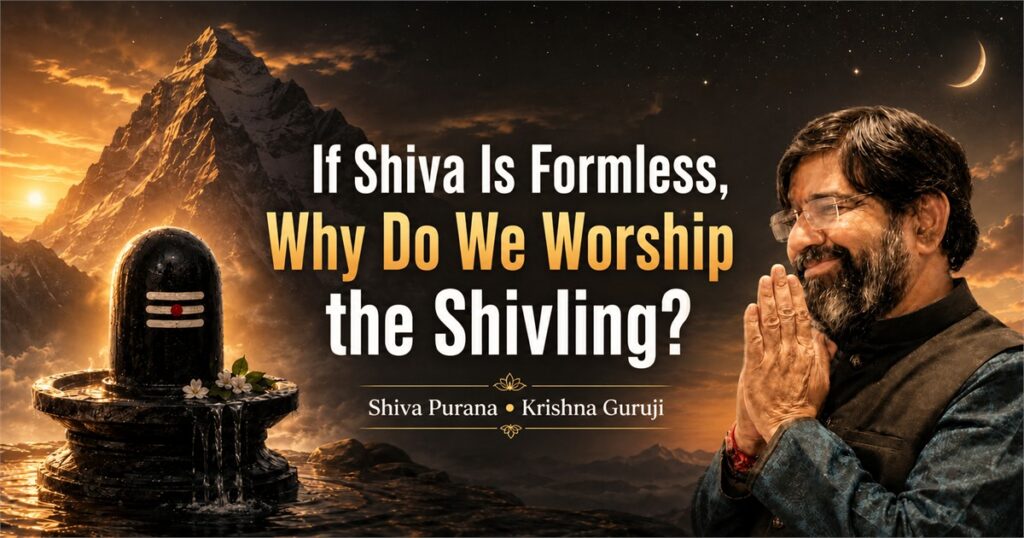
If Shiva is formless, why is the Shivling worshipped? What is the difference between a physical image of Shiva and the seemingly formless Shivling?
This question naturally arises in the minds of many young people today. Interestingly, the same inquiry appears in the Shiva Purana. The sages asked Suta Ji why Shiva is worshipped in two forms: as a recognizable divine image and as the abstract symbol of the Shivling.
This article explores the scriptural answer along with Krishna Guruji’s modern, logical and yogic perspective.
Krishna Guruji’s Special Discourse on the Shivling
Begin with Krishna Guruji’s complete discourse on this subject:
Watch the complete Shiva Purana discourse on YouTube
Where Did This Dialogue in the Shiva Purana Take Place?
The Puranas describe Naimisharanya as an important centre of spiritual learning. Many sages, including Shaunaka, gathered there and asked Suta Ji questions about dharma, spirituality and the nature of the Divine.
Suta Ji was a learned narrator of the Puranas and is traditionally regarded as a disciple in the lineage of Maharishi Vedavyasa. He answered the sages on the basis of wisdom preserved through the guruji-shishya tradition.
What Did the Sages Ask Suta Ji?
The sages observed that most deities are primarily worshipped through an anthropomorphic image. Lord Shiva, however, is worshipped both as a divine figure and in the form of the Shivling. Why do both forms exist?
A similar question appears in the Rudra Samhita: how does Nirguna Maheshwara—the Lord beyond attributes—assume a Saguna form within the world?
The dialogue can be explored in the Rudra Samhita of the Shiva Purana.
Suta Ji’s Answer: Nishkala and Sakala Shiva
Suta Ji explained Shiva through two complementary aspects:
- Nishkala Shiva: Shiva without a fixed shape, physical parts or boundaries—the unconditioned and infinite principle.
- Sakala Shiva: Shiva manifest with qualities, symbols and a recognizable form.
The Shivling points toward Nishkala Shiva: the formless, limitless reality. The image of Shiva expresses Sakala Shiva: the same reality presented through a visible form and meaningful symbols.
Therefore, the Shivling and the image of Shiva do not contradict each other. They are two ways of approaching the same Shiva-tattva.
This scriptural explanation is also found in the fifth chapter of the Vidyeshwara Samhita.
What Does the Word “Linga” Mean?
In modern usage, people sometimes connect the word “linga” only with biological identity. In Sanskrit, however, linga can also mean a mark, sign, indication, characteristic or symbol.
Even grammatical terms use linga to classify words. In the same way, Shivling can be understood as the sign or symbol through which the formless Shiva principle is contemplated.
“The Shivling is not a representation of Shiva’s body. It is a sign of His formless essence.” — Krishna Guruji
How Is the Shivling Different from an Image of Shiva?
The Shivling has no human face, arms or feet. It does not confine the mind to one physical personality or shape. It invites awareness to move beyond form.
By contrast, the image of Shiva presents many lessons through visible symbols:
- The trident reminds us of the three gunas and the need for balance.
- The damaru represents primordial sound, rhythm and the movement of creation.
- Sacred ash reminds us that the body is temporary.
- The moon represents coolness, emotional balance and mastery of the mind.
- Ganga represents knowledge and the life-giving flow of consciousness.
- The serpent represents alertness and freedom from fear.
The image of Shiva teaches us how to live. The Shivling leads meditation toward formless consciousness.
The Connection Between the Shivling and Ashtanga Yoga
Krishna Guruji also connects the Shivling with dharana, or yogic concentration.
Maharishi Patanjali describes eight limbs of yoga:
- Yama
- Niyama
- Asana
- Pranayama
- Pratyahara
- Dharana
- Dhyana
- Samadhi
Yama and niyama discipline one’s conduct. Asana steadies the body, while pranayama regulates the breath. Through pratyahara, the practitioner withdraws the senses from external distractions.
This process is often compared to a tortoise drawing its limbs inward. Dharana then gives the mind a single centre on which to rest.
How Does the Shivling Become a Focus for Dharana?
The mind usually wanders among thoughts, memories and external sights. A clear focal point helps it become steady. That focus may be the breath, a mantra, a lamp, a sacred image or the Shivling.
In Krishna Guruji’s yogic understanding, the Shivling is a powerful centre for dharana. The practitioner first looks at it with awareness, then closes the eyes and attempts to experience the same symbol inwardly.
Gradually, concentration matures into meditation. The external symbol becomes a doorway to an inner journey.
“The Shivling is visible outside, but its purpose is to connect us with the formless Shiva within.” — Krishna Guruji
Is the Shivling Merely a Stone?
Physically, a Shivling may be made from stone, metal, clay or another material. Yet devotion and spiritual practice allow that material form to carry profound meaning.
A national flag, for example, is physically a piece of cloth. Nevertheless, it represents a nation’s identity, history and collective feeling. In the same way, the Shivling becomes a sign of the infinite Shiva principle for a practitioner.
Stone itself does not punish or reward anyone. The real transformation must occur in a person’s consciousness, conduct and actions.
Shiva, Shakti and the Symbolism of Creation
Shiva and Shakti may be understood as complementary principles of consciousness and nature. Consciousness provides direction; nature gives life its form, movement and expression.
A seed is small, yet it holds the possibility of becoming a vast tree. Likewise, life develops from a subtle beginning into a body formed from the five elements.
The Shivling may therefore also be contemplated as a symbol of creative energy. Reducing it only to biological anatomy would narrow its much wider spiritual meaning. It also points toward creation, consciousness, nature and the continuity of life.
Krishna Guruji’s Independent Reflection on the Origin of the Symbol
Ancient people observed birth, death and the cycles of nature closely. They also saw that new life emerged through complementary creative forces. Such experiences may have inspired early societies to create symbols of generative power.
However, there is no single, conclusively proven historical explanation available to us. This should therefore be understood as Krishna Guruji’s independent reflection—not a literal statement of the Shiva Purana or a final archaeological claim.
Its central message is to honour the complementary powers present throughout creation.
The Modern Message of Shiva Drinking Halahala
Shiva’s protective nature is also revealed in the story of the churning of the ocean. When the deadly Halahala poison emerged, Shiva accepted it to protect the world.
This does not mean that people should consume harmful substances. Symbolically, it teaches that a capable person accepts responsibility during a crisis.
A mother may immediately place herself between danger and her child. In the same spirit, Shiva-tattva teaches us to live not only for ourselves but also for the welfare of others.
How Should We Understand Shivling Worship?
When you stand before a Shivling, look at it quietly for a few moments. Then close your eyes and allow the breath to become natural and calm.
Withdraw the scattered senses and bring awareness to one centre. Recognize within yourself the powers of creation, preservation and transformation.
When you see an image of Shiva, contemplate each symbol—the damaru, trident, ash, moon, Ganga and serpent—and reflect on the life lesson it carries.
Worship then becomes more than a ritual. It becomes a method of self-observation, concentration and inner refinement.
Why Is the Shiva Purana Relevant to Young People Today?
Young people do not want only to inherit a tradition; they also want to understand its meaning. Asking sincere questions is not opposition to faith. The right question can open the path to deeper knowledge.
The ancient sages also questioned Suta Ji. Wisdom grew through dialogue between teacher and seeker. Today, that tradition can continue through modern conversations, learning sessions and online gatherings.
Krishna Guruji plans to compile contemporary spiritual questions after his study of the eighteen Puranas. These questions may form the foundation of a future section of the Kaliyug Purana.
If Shiva Is Formless, Why Do We Worship the Shivling? The Final Answer
According to the Shiva Purana, Shiva is both Nishkala and Sakala.
The Shivling symbolizes the Nishkala aspect: formless, boundless and infinite. The image of Shiva expresses the Sakala aspect through form, attributes and sacred symbols.
In Krishna Guruji’s yogic view, the Shivling is also a centre for dharana. It draws the practitioner away from the noise of the outer world and toward inner consciousness.
Thus, the Shivling and Shiva’s image are not separate. They are two doors opening onto the same spiritual journey.
“The Shivling signifies formless Shiva. The image of Shiva is a visible explanation of His messages for living.” — Krishna Guruji
Related Spiritual Articles
- Why Is the Sudarshan Chakra on Lord Vishnu’s Index Finger?
- Why Does Lord Vishnu Rest in the Cosmic Ocean?
- How Was the Universe Created? A View from the Bhavishya Purana
- Kaliyug Purana: Logical Spiritual Questions and Answers
- Read More Spiritual Articles by Krishna Guruji
This article is based on dialogues from the Shiva Purana and Krishna Guruji’s independent Kaliyug Purana perspective. Its purpose is not to offend any faith, but to understand ancient symbols through modern and logical language.