Why was Lord Ganesha given an elephant head? Why was the head of an elephant chosen after Ganesha’s original head was severed? Why not the head of another living being?
This is an interesting question for today’s generation. The story of Ganesha’s beheading and restoration appears in the Shiva Purana, Rudra Samhita, Kumara Khanda. However, the question “Why specifically an elephant head?” also gives us an opportunity to look beyond the story and reflect on the symbolism of Lord Ganesha’s unique form.
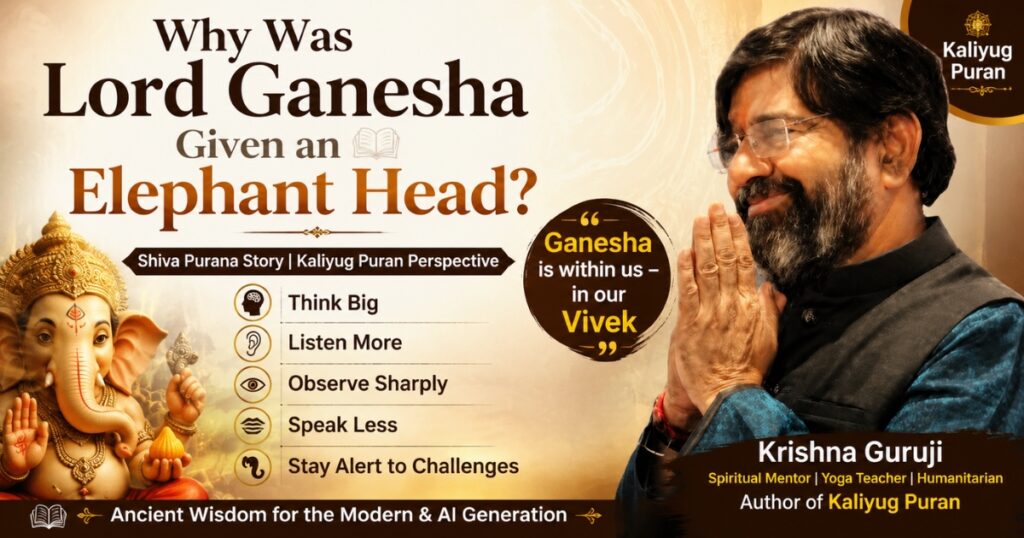
Through the perspective of Kaliyug Puran, I see Ganesha’s elephant head as a practical message for modern life: Think Big, Listen More, Speak Less and Observe Sharply.
Why Was Lord Ganesha Given an Elephant Head? What Does the Shiva Purana Say?
The Shiva Purana describes the birth of Ganesha, his confrontation with Shiva’s attendants, the battle that followed, and the severing of his head.
After Goddess Parvati learned what had happened, she was deeply distressed. Lord Shiva then arranged for Ganesha to be restored to life.
In the account found in the Rudra Samhita, Kumara Khanda, Shiva instructed his attendants to go towards the north and bring the head of the first suitable being they encountered. They found an elephant, and its head was brought and joined to Ganesha’s body. Ganesha was then restored to life and later given a place of great honour.
You can read the relevant English translation of the Shiva Purana here:
Shiva Purana – Rudra Samhita, Kumara Khanda: Resuscitation of Ganesha
However, the scripture narrates the event. The following symbolic interpretation is my reflection through the Kaliyug Puran perspective. It should not be presented as a literal explanation written in the Shiva Purana.
Ganesha’s Elephant Head and the Message of a Great Mind
Look at Lord Ganesha’s form. The first thing we notice is his large elephant head.
For me, this gives a simple message: Think Big.
No problem should become bigger than your intelligence and wisdom. Difficulties will come in life. Stressful situations may also arise. However, instead of allowing the problem to control the mind, we should use our Buddhi and Vivek — intelligence and wisdom to find the right response.
This is especially relevant to the younger generation. A large head can symbolically remind us to expand our thinking rather than magnify our problems.
Large Ears – Listen More, Speak Less
Lord Ganesha has remarkably large ears. What can they teach us?
Listen More.
Many conflicts arise because we are eager to reply before we have fully listened. We often prepare our response while the other person is still speaking.
Ganesha’s large ears can remind us to listen patiently. Listening does not mean blindly accepting everything. Rather, it means hearing carefully, understanding thoughtfully and then responding with wisdom.
Therefore, one of the simplest messages of Ganesha’s form can be:
Listen more. Understand more. React less.
Small Mouth – We Do Not Need to Speak About Everything
Compared with his large head and ears, Ganesha’s mouth appears small.
For modern life, I interpret this as another practical message: Speak Less.
Not every thought needs to become a sentence. Not every situation requires our reaction. Moreover, not every conversation deserves our energy.
Sometimes we speak merely out of habit or formality. For example, we may clearly see someone drinking tea and still ask, “Are you having tea?” Such harmless conversation is common, but it also shows how much we speak automatically without awareness.
The deeper lesson is not to stop communicating. Instead, it is to make our words more conscious, meaningful and compassionate.
Small Eyes – Observe Sharply
Lord Ganesha’s eyes are relatively small. Symbolically, they can represent focus and careful observation.
Big thinking does not mean ignoring small details. In fact, a wise person can hold a large vision while also observing subtle changes.
Therefore, Ganesha gives us a beautiful combination:
Think Big, but Observe Sharply.
Before reacting to a person or situation, look carefully. Sometimes what appears obvious on the surface may not reveal the complete truth.
The Trunk – Recognise a Problem Before It Becomes Bigger
The elephant’s trunk is another extraordinary feature of Ganesha’s form.
In my symbolic interpretation, the long trunk represents awareness and sensitivity. We should learn to notice warning signs before a small difficulty grows into a major problem.
This does not mean predicting the future. Rather, it means developing awareness.
Whether in relationships, work, family or our own behaviour, many problems give us early signals. If we remain alert, we can often respond before the situation becomes more difficult.
One Tusk – A Message of Restraint
Ganesha is also known as Ekadanta — the One-Tusked Lord.
Through the Kaliyug Puran perspective, I connect this with the traditional expression:
“Kam Khao, Gam Khao” — eat with restraint and learn to absorb life’s difficulties with patience.
The message is one of self-control. Life does not always move according to our expectations. Wisdom includes knowing what to accept, what to change and what not to react to immediately.
Ganesha’s Elephant Head and Our Sense Organs
There is another way to understand this symbolism. Much of our experience of the world comes through our sense organs.
We see something and react. We hear something and react. We speak and sometimes create another reaction.
Therefore, spiritual discipline is not only about controlling the outside world. It is also about becoming aware of what we allow into our mind and how we respond to it.
Ganesha’s form can become a daily reminder:
See consciously. Listen carefully. Speak thoughtfully.
Along With Fasting From Food, Try Practising Silence
People observe many kinds of fasts. However, sometimes we can also experiment with a simple period of Mauna — conscious silence.
This does not necessarily mean avoiding food. It can simply mean deciding that, for a certain period, we will not speak unnecessarily.
When we speak less, we naturally get an opportunity to listen more. We can also observe our urge to react immediately.
Such a practice can become a form of self-reflection rather than merely a ritual.
Do a Daily Audit of Your Senses
At the end of the day, sit quietly for a few minutes.
First, become aware of your ears. Ask yourself: What did I hear today, and how did it affect me?
Then reflect on your eyes: What did I see today, and what reactions arose within me?
Finally, think about your speech: How much did I speak? Which words were necessary? Which words could have been avoided?
This simple practice can help us understand our own patterns.
The familiar teaching — do not see evil, do not hear evil and do not speak evil — becomes more meaningful when we apply it to our daily behaviour.
How Can We Explain Ganesha’s Elephant Head to Today’s Children?
Today’s children live in the age of technology and Artificial Intelligence. They naturally ask questions.
If a child asks, “Why did Ganesha receive an elephant head?” we can certainly tell the traditional story. At the same time, we can also help the child discover the values symbolised by Ganesha’s form.
We can say:
Use a big mind for big thinking.
Use your ears to listen carefully.
Use your eyes to observe deeply.
Use your words thoughtfully.
Use your awareness to recognise problems early.
In this way, tradition can become a source of practical wisdom for the AI generation rather than remaining only a story to be memorised.
Is This Meaning of Ganesha’s Elephant Head Written in the Shiva Purana?
This distinction is important.
The Shiva Purana narrates the story of Ganesha’s birth, the battle, the severing of his head and his restoration with an elephant’s head.
However, interpretations such as “large head means Think Big” or “large ears mean Listen More” are symbolic reflections. I present them through my Kaliyug Puran perspective as practical messages for contemporary life.
The purpose is not to rewrite the scripture. Rather, it is to ask:
What can this ancient sacred form teach a human being living today?
More Shiva Purana Questions Through the Kaliyug Puran Perspective
If you enjoy exploring traditional spiritual questions with a contemporary perspective, you may also read:
Why Does Lord Shiva Carry a Trishul? – Kaliyug Puran Message
Why Did Lord Shiva Assume the Ardhanarishvara Form?
Why Do We Worship the Same Snake We Fear?
You can explore more spiritual reflections on the Krishna Guruji Blog.
Where Is Ganesha Within Us?
For me, the most important message is simple: The Shiva Purana narrates the story of Ganesha’s birth, the battle, the severing of his head and his restoration with an elephant’s head
Ganesha is within us — in our Vivek.
Lord Ganesha is worshipped as the giver of wisdom and remover of obstacles. Therefore, worship should also inspire us to awaken the intelligence and discrimination that help us overcome obstacles in our own lives.
Do not allow a problem to become bigger than your wisdom.
Think Big. Listen More. Speak Less. Observe Sharply. Live with Vivek.
That is how the image of Lord Ganesha can continue to guide even the modern and AI generation.
Watch the Complete Video: Why Was Ganesha Given an Elephant Head?
Watch Krishna Guruji explain the Shiva Purana story and its practical message through the Kaliyug Puran perspective:
Watch on YouTube – Why Was Lord Ganesha Given an Elephant Head?
Krishna Kant Mishra (Krishna Guruji)
Spiritual Mentor, Yoga Teacher, Humanitarian
Author of Kaliyug Puran