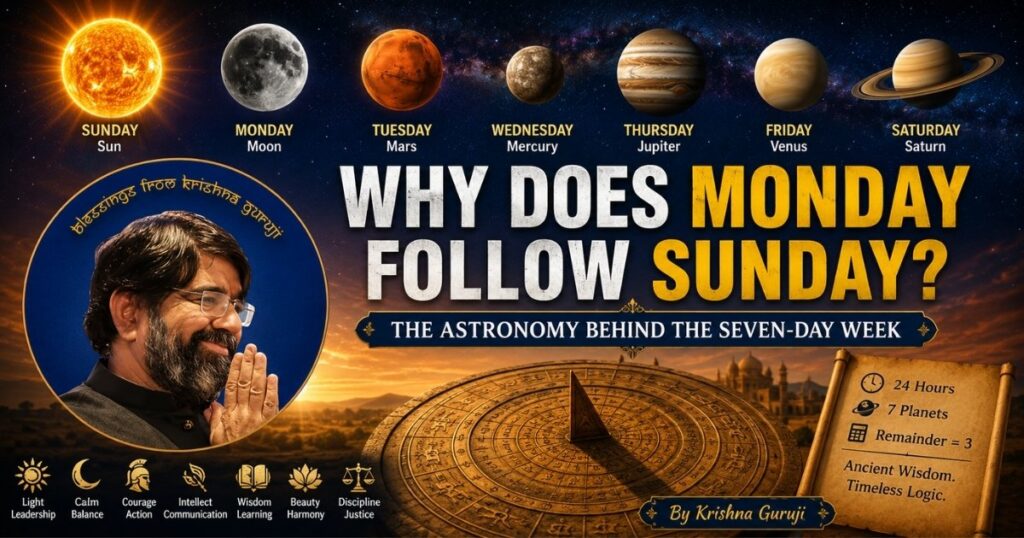
Why Does Monday Follow Sunday? The Astronomy Behind the Seven-Day Week
By Krishna Guruji
By Krishna Guruji
Have you ever wondered why Monday follows Sunday and why our calendar contains exactly seven days? We repeat the names Sunday, Monday, Tuesday, Wednesday, Thursday, Friday, and Saturday from childhood. However, most people never ask who arranged them in this particular order.
The answer is surprisingly fascinating. It brings together ancient astronomy, careful observation, mathematics, timekeeping, and later spiritual symbolism. Therefore, the weekly sequence is not simply an inherited habit. It reflects a system developed by people who closely studied the sky long before modern telescopes existed.
Why Does Monday Follow Sunday?
To understand the order of the week, we must first look at the night sky as ancient observers saw it. Thousands of stars appeared to remain fixed in relation to one another. However, seven bright celestial bodies seemed to move differently across the background of those stars.
These seven visible heavenly bodies were:
- The Sun
- The Moon
- Mars
- Mercury
- Jupiter
- Venus
- Saturn
Because these objects appeared to wander through the sky, ancient civilizations gave them special importance. Over time, these seven celestial bodies became connected with the seven-day week.
This subject also reflects the approach discussed through Kaliyug Puran: ancient knowledge should be examined with curiosity, logic, and relevance to the present age.
Did Size or Brightness Decide the Weekday Order?
At first, one may assume that the planets were arranged according to size. Nevertheless, the weekday order does not follow their actual size.
If size had decided the sequence, it would appear approximately as:
Sun → Jupiter → Saturn → Venus → Mars → Mercury → Moon
Clearly, that is not the weekly order we use.
Brightness did not decide it either. The Sun and Moon are the most noticeable objects in our sky. Venus is also extremely bright, while Jupiter is easily visible. Even so, brightness alone cannot explain why Tuesday comes after Monday or why Saturday leads back to Sunday.
Therefore, the answer lies in a different astronomical system.
The Ancient Planetary Order
Ancient astronomers arranged the seven celestial bodies according to their apparent movement across the sky, from the slowest to the fastest.
The traditional sequence was:
Saturn → Jupiter → Mars → Sun → Venus → Mercury → Moon
This order is sometimes called the classical planetary order. It was based on how slowly or quickly these bodies appeared to move from Earth.
Next, ancient timekeepers divided each day into 24 planetary hours, traditionally known as horas. Each hour received a ruler according to the same repeating planetary sequence.
The celestial body ruling the first hour gave its name to that particular day.
The Mathematics Behind the Seven-Day Week
Here is the key mathematical point: a day has 24 hours, while the planetary sequence contains seven celestial bodies.
When 24 is divided by 7, the remainder is 3.
As a result, the ruler of the first hour of the next day moves three places forward in the planetary sequence. When this pattern continues, it naturally produces the familiar weekday order:
Sun → Moon → Mars → Mercury → Jupiter → Venus → Saturn
That becomes:
- Sunday — Sun
- Monday — Moon
- Tuesday — Mars
- Wednesday — Mercury
- Thursday — Jupiter
- Friday — Venus
- Saturday — Saturn
Therefore, Monday follows Sunday because of the relationship between the seven-body planetary sequence and the 24-hour division of the day. It is an elegant combination of astronomy and arithmetic.
Does the Sun Become Stronger on Sunday?
No. The Sun does not suddenly become more powerful because people call a day Sunday.
Similarly, the Moon does not gain extra physical power every Monday, and Mars does not switch on every Tuesday. Each celestial body follows its own natural movement and cycle.
For example, solar activity is connected with the Sun’s natural processes and its approximately 11-year activity cycle. The Moon follows a lunar cycle of about 29.5 days. These cycles do not depend on the names used in our calendar.
Readers can explore more scientific information through the NASA Solar System resource and the International Astronomical Union.
Thus, weekday names are cultural and symbolic markers. They are not switches that activate planets.
The Human Qualities Symbolised by the Seven Days
Although weekday names do not control planetary power, they can still remind us of valuable human qualities.
- Sunday: Light, confidence, clarity, and leadership
- Monday: Calmness, emotional balance, and sensitivity
- Tuesday: Courage, strength, determination, and action
- Wednesday: Intelligence, learning, and communication
- Thursday: Knowledge, wisdom, guidance, and gratitude
- Friday: Harmony, creativity, beauty, and abundance
- Saturday: Discipline, patience, justice, and service
In this way, the calendar can become a tool for self-reflection. Instead of fearing a particular day or planet, a person can consciously practise the quality symbolised by that day.
This understanding is also connected with the principles behind Divine Astro Healing, where awareness, self-healing, inner balance, and yogic methods are given importance over fear.
Did the Planets Come Before the Deities?
The planetary association of weekdays developed first. Later, different cultures connected these days with their own spiritual traditions and deities.
For example, Monday was associated with Soma, the Moon. Later, it became closely connected with Lord Shiva because Shiva is traditionally shown wearing the crescent Moon.
Tuesday became associated with Lord Hanuman because of strength and courage. Wednesday became linked with Lord Ganesha through intelligence and wisdom. Thursday became the day of the Guru and divine knowledge. Friday became associated with Goddess Lakshmi, beauty, harmony, and abundance. Saturday became connected with Lord Shani, discipline, karma, and justice.
Therefore, astronomy provided the structure, while spirituality added meaning and cultural expression.
Readers interested in Shiva symbolism may also explore the deeper meaning of Om Namah Shivaya and the spiritual understanding of Rudrabhishek.
Science and Spirituality Can Walk Together
True spirituality does not fear honest questions. Likewise, genuine science grows through observation, enquiry, and testing.
The seven-day week offers a beautiful example of how astronomy, mathematics, history, and symbolism can exist together. Science explains how the planetary-hour system produced the weekday order. Spiritual thought helps us use each day as an opportunity for inner development.
Rather than opposing each other, science and spirituality can deepen our understanding of nature and human life.
You may learn more about this approach and the humanitarian journey of Krishna Guruji.
A Closing Reflection
The Sun does not switch on because it is Sunday. However, a person can choose to bring clarity and light into life.
The Moon does not suddenly control Monday. Nevertheless, the human mind can choose calmness and balance.
Mars does not become active only on Tuesday. Yet a person can consciously act with courage and determination.
The day does not activate the planet. Instead, the planet’s name can remind us of the quality it represents.
Perhaps that is the deeper wisdom hidden within the seven-day week: not planetary fear, but daily self-improvement.
— Krishna Guruji
Frequently Asked Questions
Why are there seven days in a week?
The seven-day week was connected with the seven celestial bodies visible to ancient observers: the Sun, Moon, Mars, Mercury, Jupiter, Venus, and Saturn.
Why does Monday come after Sunday?
The ancient planetary-hour system divided each day into 24 hours. Since 24 divided by seven leaves a remainder of three, each new day’s first planetary hour moves three places forward, creating the familiar weekday order.
Are weekdays based on astronomy?
Yes. Their names and sequence are connected with the seven classical celestial bodies and the traditional planetary-hour system.
Does a planet become stronger on its weekday?
No. Celestial bodies follow their own natural cycles. Weekday names are symbolic and cultural rather than physical switches that activate planets.
What lesson can we learn from the weekday names?
Each day can remind us of a positive quality, such as clarity, calmness, courage, wisdom, harmony, discipline, and service.