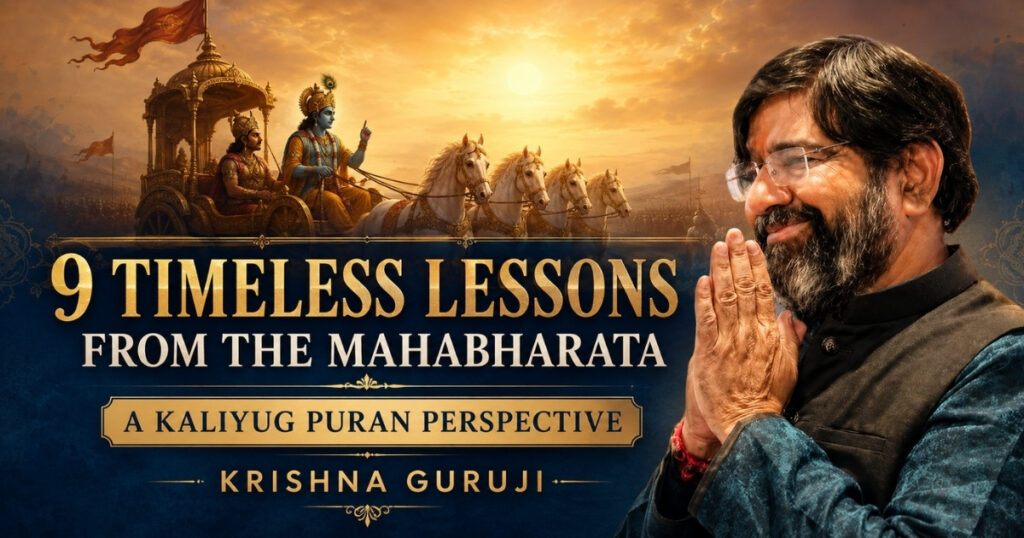
Mahabharata’s 9 Timeless Lessons for Life in Kaliyug: A Kaliyug Puran Perspective
The Mahabharata is not merely the story of an ancient war. Instead, it is a timeless guide to human nature, relationships, power and duty.
Traditionally, the Mahabharata contains about 100,000 shlokas. Therefore, it is regarded as one of the longest epic poems in the world. However, its essential wisdom can also be understood through a few powerful lessons.
You may follow any religion. You may be a man or a woman. Similarly, you may be rich or poor. You may live in India or abroad. Yet, the teachings of the Mahabharata can guide every human being.
This article explains nine lessons through the modern and practical vision of Kaliyug Puran. Kaliyug Puran connects ancient spiritual wisdom with the challenges of present-day life.
What Is the Kaliyug Puran Perspective?
Kaliyug Puran does not ask us to worship a character blindly. Instead, it encourages us to understand the message hidden in that character’s journey.
According to Krishna Guruji, every person in the Mahabharata represents a human quality. For example, Dhritarashtra represents blind attachment. Duryodhana represents uncontrolled jealousy. Arjuna represents confusion followed by awakening.
Therefore, the real question is not who won the ancient war. The real question is: Which Mahabharata character is controlling our decisions today?
1. Uncontrolled Desires Can Make Parents Helpless — The Kauravas
Parents naturally want to keep their children happy. However, fulfilling every unreasonable demand is not true love.
Dhritarashtra repeatedly ignored Duryodhana’s mistakes. His attachment stopped him from correcting his son at the right time. Consequently, Duryodhana’s jealousy and arrogance continued to grow.
Children need affection. Nevertheless, they also need discipline and boundaries. They must learn the difference between a genuine need and an uncontrolled desire.
Kaliyug Puran lesson: Give children love, values and guidance. However, do not give them unlimited freedom to follow every desire.
2. Power Becomes Meaningless When It Supports Adharma — Karna
Karna was courageous, generous and highly skilled. Even so, he continued to support Duryodhana when injustice was taking place.
His loyalty towards his friend became stronger than his loyalty towards dharma. As a result, his talent and strength could not protect him.
This lesson is relevant today. A friend, relative, employer or leader may be wrong. At that moment, remaining silent can also become indirect support for injustice.
Kaliyug Puran lesson: Loyalty is valuable. However, loyalty should never become an excuse for supporting wrongdoing.
3. Knowledge Without Values Can Cause Destruction — Ashwatthama
Ashwatthama possessed knowledge of divine weapons. However, anger and revenge influenced his actions.
Knowledge itself is neither good nor bad. Its result depends on the intention of the person using it.
This lesson is especially important today. Science, technology, artificial intelligence and social media offer great power. Yet, without ethics, the same tools can spread hatred and destruction.
Kaliyug Puran lesson: Give the next generation knowledge. At the same time, teach compassion, patience and responsibility.
4. Never Make a Promise That Forces You to Support Wrongdoing — Bhishma Pitamah
Bhishma Pitamah was respected for his discipline and sacrifice. However, his vows tied him to the throne of Hastinapur.
Although he recognised injustice, his commitments limited his ability to oppose it. Therefore, his life teaches us to think carefully before making a lifelong promise.
A promise is sacred when it protects truth. However, a promise that forces us to remain silent before injustice must be examined again.
Kaliyug Puran lesson: Do not allow an old commitment to imprison your conscience.
5. The Misuse of Power Eventually Leads to Ruin — Duryodhana
Duryodhana had wealth, authority and powerful supporters. Yet, he lacked contentment and moral clarity.
His jealousy towards the Pandavas slowly became an obsession. Instead of using his position for public welfare, he used it to satisfy his pride.
Power reveals a person’s true nature. In responsible hands, it can protect society. In arrogant hands, however, it can create fear and destruction.
Kaliyug Puran lesson: The misuse of wealth, strength and authority eventually leads to downfall.
6. Never Give Power to Someone Blinded by Attachment — Dhritarashtra
Dhritarashtra was physically blind. However, his greater weakness was his blind attachment towards his son.
He knew that Duryodhana was acting unjustly. Nevertheless, he failed to take firm action.
Blindness is not always physical. A person may be blinded by greed, pride, selfishness, anger, lust or attachment.
This principle applies to families, organisations and governments. Leadership requires fairness, courage and clear vision.
Kaliyug Puran lesson: Never hand over responsibility to someone whose judgement is controlled by ego or attachment.
7. Knowledge Guided by Wisdom Leads to Victory — Arjuna
Arjuna was a highly skilled warrior. However, before the battle, confusion took control of his mind.
At that critical moment, Lord Krishna gave him the wisdom of the Bhagavad Gita. Krishna taught him about duty, action, detachment and the eternal soul.
Knowledge gives us ability. In contrast, wisdom tells us when and how to use that ability.
Kaliyug Puran lesson: When knowledge joins wisdom, discipline and the right guidance, victory becomes possible.
8. Deception Cannot Bring Lasting Success — Shakuni
Shakuni was intelligent and strategic. However, he used his intelligence to manipulate others and create conflict.
For a while, his plans appeared successful. Nevertheless, success achieved through deception could not last.
Manipulation may provide a temporary advantage. Eventually, however, it destroys trust, relationships and inner peace.
Kaliyug Puran lesson: Deception may win a moment, but it cannot ensure a lasting victory.
9. Dharma Is the Strongest Protection — Yudhishthira
Yudhishthira faced humiliation, exile and many difficult tests. He also made mistakes. Still, he repeatedly tried to return to truth and duty.
Dharma does not guarantee an easy life. A righteous person may also experience suffering. However, dharma provides the inner strength required to face hardship without losing humanity.
Kaliyug Puran lesson: If you uphold morality, goodness and duty, temporary difficulties cannot destroy your inner strength.
The Real Kurukshetra Exists Within Us
The Mahabharata is a mirror of human behaviour. Its characters represent qualities that still exist within society and within us.
Sometimes, attachment makes us blind like Dhritarashtra. At other times, jealousy influences us like Duryodhana. Similarly, we may possess knowledge but lack balance like Ashwatthama.
We may also feel confused like Arjuna. At such moments, we need the inner wisdom represented by Lord Krishna.
Therefore, the real Kurukshetra is not only an ancient battlefield. It also exists in the human mind. Every day, truth and falsehood compete within us. Duty and selfishness also compete. Likewise, patience struggles against anger.
To understand more practical spiritual teachings for modern life, explore the Kaliyug Puran and E-Book collection on KrishnaGuruji.com.
Krishna Guruji’s Message
“The Mahabharata should not be read only to judge its characters. Instead, we should recognise those characters within ourselves. When we overcome our inner Duryodhana, Shakuni and Dhritarashtra, the Krishna within us begins to guide the Arjuna within us.”
According to Krishna Guruji Krishna Kant Mishra, success without morality cannot create lasting happiness. Therefore, we should ask ourselves one question every day:
“Is my decision guided by ego, attachment and fear, or by truth, compassion and duty?”
An honest answer can change the direction of our life.
Final Thoughts
The Mahabharata belongs to all humanity. Its wisdom is not limited by religion, gender, nationality or social status.
These nine lessons teach us to control desire and use knowledge responsibly. Moreover, they remind us to choose leaders carefully and never misuse power.
Most importantly, the Mahabharata teaches that the greatest victory is victory over our own anger, greed, pride, jealousy and attachment.
For a broader historical introduction to the epic, readers may also visit the Encyclopaedia Britannica overview of the Mahabharata.
Read these lessons slowly. Then, reflect on them honestly. Finally, share them with your family and friends.
“Sarve Bhavantu Sukhinah, Sarve Santu Niramayah.”
May everyone be happy. May everyone remain healthy and free from suffering.
Always remain happy. What you have is sufficient when your heart is filled with gratitude.
— Krishna Guruji Krishna Kant Mishra
Author, Kaliyug Puran
KrishnaGuruji.com